
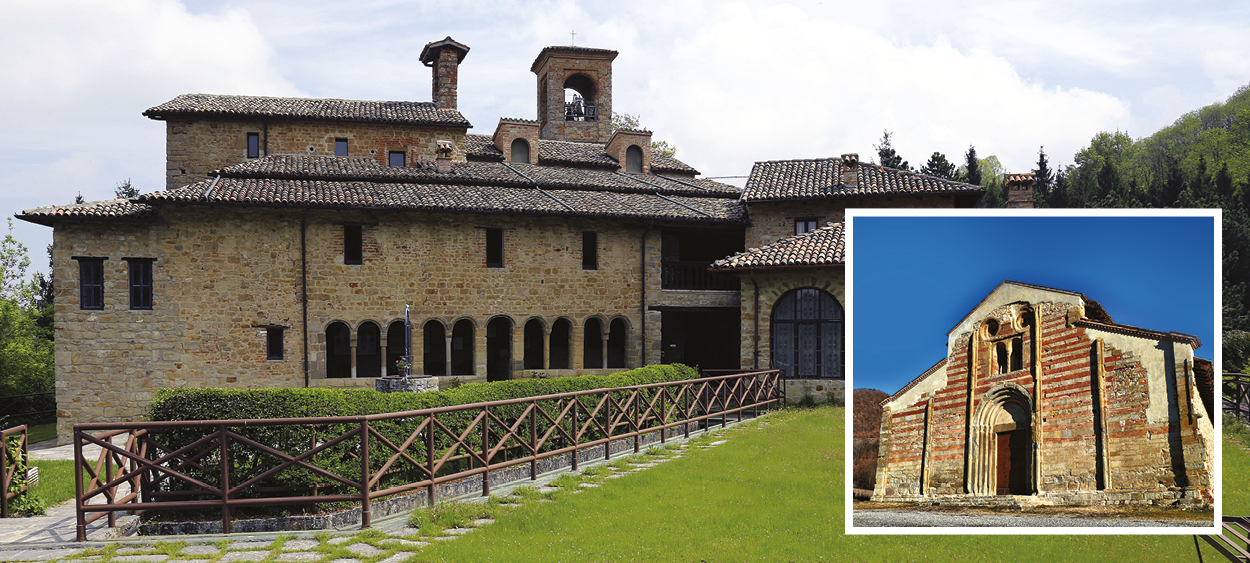
Abbeys and Sacred Places Along the Greenway
A crossroads for goods and people, the area crossed by the Voghera-Varzi Greenway is dotted with places of pilgrimage and worship of great significance—likely due to its strategic location along the Lombard Salt Route, just a few kilometers from its intersection with major pilgrimage routes such as the Via Francigena, the Via degli Abati, and the Way of St. Columbanus.
It’s certainly no coincidence that the two main patron saints of Voghera, St. Bovo and St. Roch—both of whom died in the city—were French pilgrims traveling to or from Rome. The first, a Provençal knight known for fighting the Moors, is venerated in a precious ark at the foot of the high altar of the cathedral as the city’s patron. The second, a nobleman from Montpellier and protector against the plague, is the patron of the church that houses his relic—an arm—after his body was stolen by the Venetians, who dedicated one of Venice’s Baroque masterpieces to him.
Leaving Voghera and starting the walk toward Varzi along the Greenway, you’ll encounter many more churches, abbeys, and traces of a long history of faith and devotion. What follows is a journey through the most representative sites, between past and present.
Church of the Holy Trinity — Rivanazzano Terme
Located in the historic center of Rivanazzano Terme, right behind the famous Brugnatelli Park, the small Church of the Holy Trinity is notable for housing the oldest pipe organ in the Province of Pavia and one of the oldest in Lombardy, built in 1629. It also features a painting by the artist Paolo Borroni.
Parish Church of San Zaccaria — Rocca Susella
One of the oldest churches in the entire Oltrepò Pavese. Deconsecrated and converted into an agricultural building between the 19th and 20th centuries, it was restored to its original function during the 20th century. The gabled façade, alternating sandstone and brick bands, reveals its medieval origins (12th century), likely the work of Comacine masters, who also crafted the finely sculpted capitals inside.
Church of Saint Martin Bishop — Cecima
The original church dates back to the 11th century, but due to a landslide, it was rebuilt in the 15th century in its current form, featuring a gabled sandstone façade decorated with terracotta tiles.
Abbey of Sant’Alberto di Butrio — Ponte Nizza
A true medieval gem, Sant’Alberto is one of the most fascinating places in Oltrepò for those seeking a spiritual experience, a nature walk, or a historical visit. Surrounded by chestnut and beech trees, the abbey was founded shortly after the year 1000, when—according to legend—the hermit Albert, probably a member of the Malaspina family, healed the son of the Marquis of Casalasco, also a Malaspina. In gratitude, he built a church dedicated to the Virgin Mary. Around this original nucleus, new churches and a monastery with two cloisters were built.
The bell tower, visible from afar, was built in the 19th century on top of a solid 12th-century square tower, but the true wonder lies inside: a grand cycle of 15th-century frescoes covering almost every surface with depictions of saints, prophets, biblical scenes, and the life of St. Catherine.
The abbey hosted notable guests such as Frederick Barbarossa and Dante, and, according to some records, even King Edward II of England, who is said to have died there in the 14th century.
Church and Hermitage of San Ponzo — Ponte Nizza
Just beyond Ponte Nizza lies San Ponzo Semola—formerly an independent municipality where, in the 3rd century AD, Saint Ponzo lived as a hermit. Today, you can reach it by leaving the Greenway and heading east. In the heart of this charming village stands the parish church dedicated to him, originally built in the 11th century but largely restored in the 15th century. It contains frescoes from the 16th and 18th centuries, a 12th-century baptismal font, and the saint’s relics—except for his head, which is kept in the nearby Church of San Giorgio in Fortunago.
Nearby, you can also visit the natural caves where the hermit lived, at the foot of Mount Vallassa, in front of which a small chapel was later built.
Church of the Capuchins — Varzi
Originally the parish church of Varzi, dedicated to Saint Germanus, the current Church of the Capuchins stands at the entrance of the town, just a few hundred meters from the village. The present structure was built in the 12th century to replace an even older one from the 5th century and remained the main place of worship for the upper Staffora Valley until the 16th century, when the current parish church was built within the town walls. At that point, it became the Capuchin church, and after the Napoleonic suppression, the Capuchins regained ownership in the early 20th century.
The gabled façade is striking, featuring a wide banded stone base topped with brickwork, reflecting a hybrid style transitioning between Romanesque and Gothic, also seen in other architectural and decorative elements of the church. The interior preserves fragments of frescoes of great interest.
Temple of the Brotherhood of Peoples — Varzi
This is not an ancient parish church or a grand monastery, but the result of a unique project. The Temple of the Brotherhood of Peoples was established in the 1950s by Don Adamo Accosa, a military chaplain and war veteran, who decided to build a place of worship using debris and remains from World War II. He was supported by then-Archbishop Angelo Roncalli (the future Pope John XXIII).
The result is a truly unique site where weapons and military vehicle parts, an altar stone from a church destroyed after the Normandy landings, ship fragments, spires from the Milan Cathedral damaged by bombings, and remnants from London, Dresden, Warsaw, Hiroshima, and Nagasaki form the building and its furnishings—turning the remnants of war into symbols of peace and fraternity.
The Temple is open to visitors. Once in Varzi, head up to the hamlet of Cella, at an altitude of 700 meters above sea level.
Parish Church of Someglio — Brallo di Pregola
Straddling the Staffora and Trebbia valleys, at 750 meters above sea level, stands the ancient church—called a “pieve” due to its medieval administrative and religious functions—of Someglio. Dedicated to Saints Gervasius and Protasius, it was built between the 12th and 13th centuries as the main place of worship for the higher Malaspina lands. Its tall bell tower is particularly striking—originally a true watchtower thanks to its strategic position, which still offers views over the Avagnone valley, Mount Lesima, and Cima Colletta.