
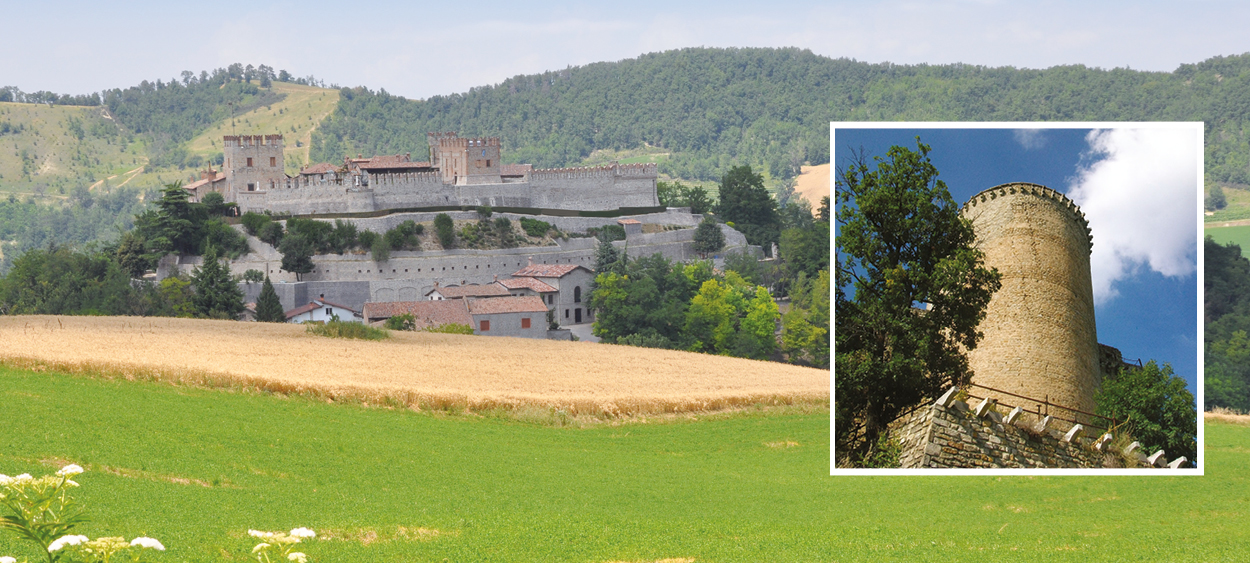
Castles of Oltrepò along the Greenway
Oltrepò Pavese, like much of the Province of Pavia, is land rich in castles and medieval heritage; it’s no coincidence that the Lombards established the center of their kingdom here almost fifteen hundred years ago.
Riding along the Voghera-Varzi Greenway, you will encounter numerous castles and fortresses, some private, others open to visitors, all fascinating even if seen only briefly while cycling or walking this green path.
The first castle appears right in Voghera, and from there the journey continues among battlements and towers up to the Witch Tower of Varzi.
Visconteo Castle of Voghera
Built upon a fortification possibly dating back to the first millennium, the current Voghera Castle was commissioned by the Visconti family in the late 14th century. After the Visconti rule ended, the castle changed hands multiple times until the 18th century, when Voghera became a province and the castle housed various Savoy offices, including the judiciary. Converted into a prison in the early 1800s and largely abandoned after World War II, it was restored beginning in 1997. Inside, it still holds several frescoes, including works attributed to Bramantino depicting the Muses. It also contains Italy’s first permanent camera obscura.
Open to visitors.
Ruins of Mondondone Castle — Codevilla
Perched on the hill overlooking Codevilla and the plains, the once-important fortress of Mondondone was likely built as early as the 10th century and served as the main power center of the area. Owned successively by the Malaspina family, the Monastery of the Senator of Pavia, the Beccaria family, and the Rovida counts until the abolition of feudalism. Today, only some masonry traces remain in the heart of the small village.
Open to visitors.
Retorbido Castle
Actually an 18th-century palace built by the Durazzo Pallavicini family, characterized by two twin square towers visible from the Greenway. Its imposing structure dominates the town center and recalls Retorbido’s past as a spa destination.
Not open to visitors.
Nazzano Castle — Rivanazzano Terme
Located at the entrance of the Staffora Valley, Nazzano Castle was one of two defensive points (along with Montalfeo Fortress) controlling the Lombard Salt Road. Built from the 11th century onwards, it belonged to the Malaspina, Sannazzaro, and Mezzabarba families before passing to the Roverato marquises. Its current Gothic features come from restorations carried out in the early 20th century. Its tall battlemented tower stands out along the Voghera-Varzi Greenway in the Apennine section.
Not open to visitors.
Montalfeo Fortress — Godiasco Salice Terme
Owned by the Malaspina family, this fortress was strategically important but was razed twice: first in 1398 by order of Gian Galeazzo Visconti, then again in 1523 by command of Francesco II Sforza. The current castle was rebuilt on its ruins, with restoration campaigns in the 1920s and early 2000s.
Not open to visitors.
Ghislanzoni Fortress — Rocca Susella
Dating back to the 11th century, this fortress guarded the entrance to the Ardivestra Valley. Originally part of the Tortona bishopric fief, it was given first to the Ruino family of Montepico and later to the Dal Verme family. In the 18th century, it belonged to the Gambarana family and then to the De’ Ghislanzoni. It is a complex structure with buildings from different eras: the slender tower with Ghibelline battlements, the 16th-century central body, the 19th-century terrace, and the 18th-century oratory of the Immaculate Conception.
Not open to visitors.
Montesegale Castle
Dominating the central part of the Ardivestra Valley (a tributary of the Staffora River), it dates back to the 11th century. Surrounded by a strong square Ghibelline wall, it comprises many buildings from different periods, the oldest probably being a large bastioned earthwork topped by a small fortress and a low tower. It remained the fief of the Palatine Counts of Lomello and their descendants, the Gambarana family. Today, after extensive restorations, it also houses a contemporary art museum.
Occasionally open to visitors.
Ruins of Pizzocorno Castle — Pontenizza
Outside the town, in a dominant position over the Staffora Valley and the entrance to the Nizza Valley, there were once two castles. Of one, probably built in the 12th century, some masonry traces remain amid the vegetation.
Open to visitors.
Oramala Castle — Val di Nizza
The heart of the Obertenghi domain, Oramala Castle was built in the 10th century on a rocky spur at 758 m above sea level, overlooking the Staffora Valley above Varzi. The Malaspina family, who inherited the castle, made it a refined cultural center that hosted Provençal troubadours and perhaps even Dante. The castle’s current appearance dates to 1474, when Manfredi Malaspina fortified it by adding a large semicircular tower, making it recognizable from a great distance. Abandoned in the 18th century, it was fully restored at the end of the 20th century.
Occasionally open to visitors.
Casarasco Castle — Val di Nizza
A stronghold of the Obertenghi and later the Malaspina, it was built in the 9th century near the Abbey of Sant’Alberto di Butrio. Some evident traces remain in the large, lowered square tower and the entrance portal.
Not open to visitors.
Ruins of Bagnaria Castle
A fortified village in the middle of the Staffora Valley, Bagnaria once had an important castle located at the highest point near today’s parish church. The castle fell into ruin due to two earthquakes: the first in 1551 caused serious damage, and the second in 1828 caused the final collapse of the tower. A corner and some wall sections are still visible along the streets leading to Piazza San Bartolomeo.
Open to visitors.
Malaspina Castle and Witch Tower — Varzi
Located on the upper edge of the town, the current Varzi Castle was built by the Malaspina marquises in the 13th century, following the division of the dynasty into the Spino Fiorito and Spino Secco branches and the establishment of the Varzi marquisate by the latter. Overlooking the town hall square, the castle consists of several buildings and is essentially divided into three main sections:
- The ancient 13th-century core, recently restored, including stables, icehouses, and cellars;
- The part facing the square, built between the 16th and 18th centuries, constituting Palazzo Odetti (the counts, heirs of the Malaspina, who currently own the castle);
- The Witch Tower, dating to the 13th century and 29 meters high, once owned by the Malaspina and the Sforza families, now property of the municipality. Its name derives from its use as a prison and, according to tradition, the site of the trial and execution of 25 men and women accused of witchcraft in the nearby square in 1460.
Occasionally open to visitors.
Pietragavina Castle — Varzi
The fortress overlooks Varzi from 860 meters altitude and guards the passage toward the Tidone Valley. Built in the 12th century and attributed to the Malaspina family, it later passed to the Dal Verme in the 15th century and to the Tamburelli family of Bagnaria in the early 18th century. It features a large central keep and a semicircular defensive enclosure, both equipped with Guelph battlements.
Not open to visitors.